
DataPLANT Participating and Presenting at 1st OA Workshop in Göttingen
Fri Nov 28 2025
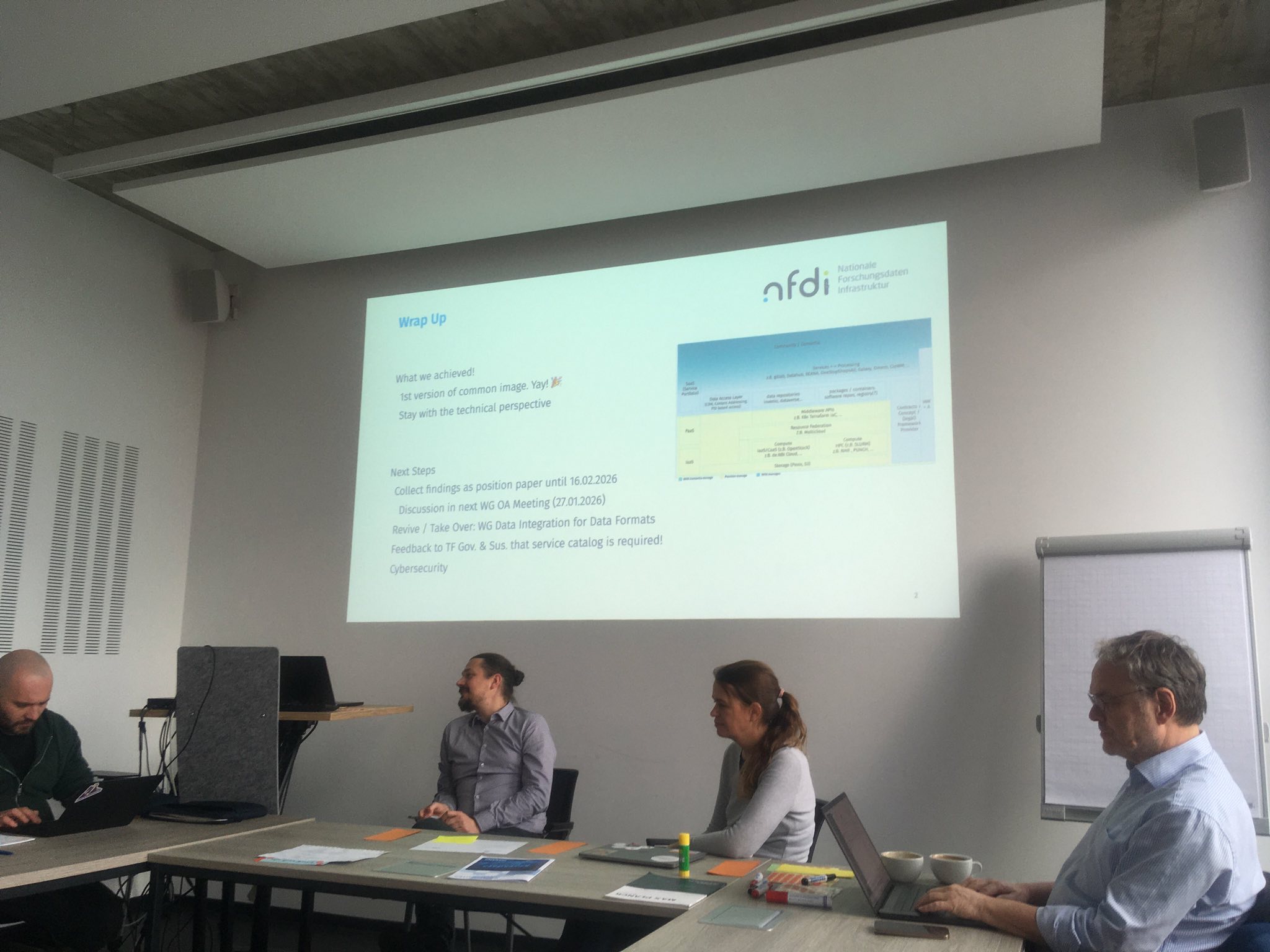
DataPLANT was actively involved in the 1st Open Access Workshop held in Göttingen end of November, contributing valuable insights and sharing experiences from its ongoing work in overall architecture design for the NFDI. The event, which focused on the future technical foundations of the National Research Data Infrastructure, brought together experts and practitioners to explore best practices, interoperability, and collaborative solutions for managing scientific data. Philipp Wieder from the GWDG kicked off the workshop with an introduction to the overarching concept of the Working Group (WG) on Open Architecture stating, “We can change the future of NFDI here.** The session covered the group’s objectives outlined in the WG Charter, which includes focusing on best practices and ensuring interoperability. Wieder acknowledged that while there won’t be a one-size-fits-all solution for scientific data management, the collective effort could significantly improve how data is stored, shared, and used across disciplines.
Marius Politze from RWTH Aachen provided updates on the Storage Call, a key initiative for advancing the underlying base level infrastructure for the scientific community, underlining that effective data storage is not merely a technical requirement but an integral part of how research is conducted and shared.
During the first day of the workshop, DataPLANT presented among the other consortia a flash talk delivered by Dirk von Suchodoletz, showcasing the project’s cloud-oriented architecture. The DataPLANT infrastructure consists of three key layers of Persistent Storage Layer, the Dynamic Disposable Layer of cloud-like (micro)services that can be flexibly deployed and scaled and the single entry user Interface functioning as a science gateway, providing users with a consistent entry point to access domain specific data and services. After the consortia flash talks, Bjoern presented the current state of the EOSC federation and what has been done during the NFDI EOSC Node build-up phase.
A key feature of the DataPLANT architecture is its flexibility, enabling researchers to switch between different technical solutions depending on their needs. This approach follows the Software as a Service (SaaS) principle, which has been successfully employed by platforms like Galaxy, a project that plays a central role in DataPLANT’s service design. Further, DataPLANT shared the lessons learned from nearly four years of production of the PLANT DataHUB, with a particular focus on the challenges related to storage. “Storage is the greatest challenge and the key point,” he remarked, underscoring the importance of reliable and scalable storage solutions for large-scale scientific data.
The various presentations showed the similarities between the architecture sketches proposed by the consortia, with many of them advocating for a single entry point for data access, which is increasingly seen as a common requirement across scientific communities.
On the second day of the workshop, participants engaged in interactive Barcamp sessions, where different consortia and participants shared their perspectives on key topics related to the overall architecture of the NFDI ecosystem. Barcamp 1 focused on defining the Common Building Blocks of an overarching architecture, drawing from the presentations made by the de.NBI and various consortia. The session delved into defining consortia and provider scopes, as well as overarching topics such as contracting, Identity and Access Management (IAM), and accounting. Further Barcamp sessions covered a variety of specialized topics, including Fair Data Objects and data products as foundational components. Data Meshes as a potential cross-community common ground for decentralized data management. DataPLANT brought in ARC RO-crates as a real-world example of standardized FDO.
One of the key takeaways from these sessions was the importance of standardization. Participants agreed that consortia should push for standardization through the nearest neighbor principle—where groups with similar goals and interests work together to advance joint understanding and shared standards. An example of such a group is the Biodata SIG, which has been instrumental in promoting common standards and frameworks for sharing and accessing biological data.
The 1st OA Workshop in Göttingen served as a crucial platform for advancing the conversation about the future of data architecture in the context of the NFDI. DataPLANT’s participation highlighted the project’s ongoing efforts to build flexible, scalable, and interoperable data solutions for fundamental plant research which could be deployed for further scientific communities as well. The workshop’s focus on collaborative design, best practices, and the need for standards sets the stage for continued progress in building a robust and sustainable research data infrastructure.
Further Links